

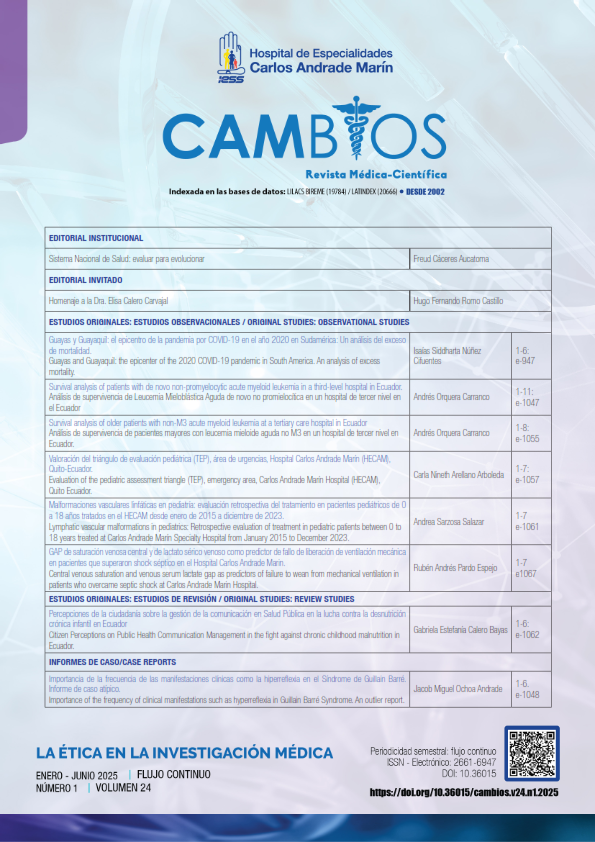
Periodicidad semestral: flujo continuo.
ISSN - Electrónico: 2661-6947 / DOI: 10.36015 • LILACS BIREME (19784); LATINDEX (20666)
INTRODUCTION: Mechanical ventilation release protocols do not consider cardiac performance during a very challenging test such as the spontaneous ventilation test.
OBJECTIVES: To determine whether the variation of central venous oxygen saturation and venous
serum lactate can predict failure of mechanical ventilation release in patients who overcame septic shock at the Carlos Andrade Marín Hospital during the period October 2018 to June 2019.
MATERIALS AND METHODS:
A descriptive, observational, cross-sectional study was developed. The data was analyzed of 62 patients were obtained during this period, with a 69.6% higher
prevalence of the male gender. The median age is 62 years (IQR 47-80) where 46.8% belong to the group over 65 years. The average number of hospitalization days is 9.8 ± 5.94 days. The average of mechanical ventilation days was 5.54 with a standard deviation of 3.2 days. The APACHE II average
at admission was 20.41 ± 6.50. The infection site with the highest prevalence was pulmonary with a
representativeness of 50%. The average value for the SOFA at the time of the test was 6.19 ± 2.98.
The 75.8% of patients showed success in mechanical release. The reintubation rate was 11.29%.
The cut-off point for the central venous saturation delta was greater than 4.5% with a sensitivity of
91, 43% and a specificity of 66.6%, (OR = 12.28; 95% CI 2.90: 51,94), VPP; 53.3% and NPV; 86%
ROC; 84.10% (95% CI 71.6%; 96.6%). Serum venous lactate was not significant to predict mechanical release failure. The significant covariates for the regression model are APACHE II at admission and
the Charlson Index with a 90.3% prognosis of failure in ventilation release and a significance for the
model of p = 0.00.
CONCLUSIONS: The difference in central venous oxigen saturation was significat to predict the failure in the release of mechanical ventilation.
1. Annane D, Aegerter P, Jars-Guincestre MC, Guidet B. Current Epidemiology of Septic Shock: The CUB-Réa Network. Am J Respir Crit Care Med. 15 de julio de 2003;168(2):165-72. DOI: 10.1164/rccm.2201087. Available from:
https://pubmed.ncbi.nlm.nih.gov/12851245/
2. Esteban A, AlíA I, Tobin MJ, Gil A, Gordo F, Vallverdú I, et al. Effect of Spontaneous Breathing Trial Duration on Outcome of Attempts to Discontinue Mechanical Ventilation. Am J Respir Crit Care Med. febrero de 1999;159(2):512-8. DOI: 10.1164/ajrccm.159.2.9803106 . Available from: https://pubmed.ncbi.nlm.nih.gov/9927366/
3. Béduneau G, Pham T, Schortgen F, Piquilloud L, Zogheib E, Jonas M, et al. Epidemiology of Weaning Outcome according to a New Definition. The WIND Study. Am J Respir Crit Care Med. 15 de marzo de 2017;195(6):772-83. https://doi.org/10.1164/rccm.201602-0320OC . Available from: https://www.atsjournals.org/doi/10.1164/rccm.201602-0320OC
4. Esteban A, Alia I, Ibañez J, Benito S, Tobin MJ. Modes of Mechanical Ventilation and Weaning. Chest. octubre de 1994;106(4):1188-93. DOI: 10.1378/chest.106.4.1188. Available from: https://pubmed.ncbi.nlm.nih.gov/7924494/
5.Teixeira C, da Silva NB, Savi A, Vieira SRR, Nasi LA, Friedman G, et al. Central venous saturation is a predictor of reintubation in difficult-to-wean patients*: Crit Care Med. febrero de 2010;38(2):491-6. DOI: 10.1097/CCM.0b013e3181bc81ec. Available from: https://pubmed.ncbi.nlm.nih.gov/19789441/
6. Jubran A, Tobin MJ. Pathophysiologic basis of acute respiratory distress in patients who fail a trial of weaning from mechanical ventilation. Am J Respir Crit Care Med. marzo de 1997;155(3):906-15. DOI: 10.1164/ajrccm.155.3.9117025. Available from: https://
pubmed.ncbi.nlm.nih.gov/9117025/
7. Guyton,A. C & Hall, J. E. (2012). Tratado de fisiología médica (12ª ed.). Elsevier Unidad VII:Respiración: p 465. ISBN: 9788480868198.
8. Feihl F, Broccard AF. Interactions between respiration and systemic hemodynamics. Part I: basic concepts. Intensive Care Med. enero de 2009;35(1):45-54. DOI: 10.1007/s00134-008-1297-z. https://pubmed.ncbi.nlm.nih.gov/18825367/
9. Feihl F, Broccard AF. Interactions between respiration and systemic hemodynamics. Part II: practical implications in critical care. Intensive Care Med. febrero de 2009;35(2):198-205. Available from: https://link.springer.com/chapter/10.1007/978-3-642-01769-8_63
10. Hernández-López GD, Cerón-Juárez R, Escobar-Ortiz D, Graciano-Gaytán L, Gorordo-Delsol LA, Merinos-Sánchez G, et al. Retiro de la ventilación mecánica: Med. crit (Col Mex Med Crit)
31 (4). jul ago 2017. Available from:
https://www.scielo.org.mx/scielo.php?script=sci_arttext&pid=S2448-89092017000400238
11. Martin J. Tobin, Amal Jubran. Principles and practice of mechanical ventilation. third edition. 2013. Available from: https://accessmedicine.mhmedical.com/content.aspx?bookid=520§ionid=41692233
12. Esteban A, Alía I, Gordo F, Fernández R, Solsona JF, Vallverdú I, et al. Extubation outcome after spontaneous breathing trials with T-tube or pressure support ventilation. The Spanish Lung Failure Collaborative Group. Am J Respir Crit Care Med. agosto de 1997;156(2 Pt 1):459-65. DOI: 10.1164/ajrccm.156.2.9610109 . Available from:
https://pubmed.ncbi.nlm.nih.gov/9279224/
13. Esteban, et al., E et al. A Comparison of Four Methods of Weaning Patients from Mechanical Ventilation. N Engl J Med. 1995;6. DOI: 10.1056/NEJM199502093320601 Available from: https://pubmed.ncbi.nlm.nih.gov/7823995/
14. Karthika M, Al Enezi FA, Pillai LV, Arabi YM. Rapid shallow breathing index. Ann Thorac Med. 2016;11(3):167-76. DOI: 10.4103/1817-1737.176876. Available from: https://pubmed.ncbi.nlm.nih.gov/27512505/
15. Sklar MC, Burns K, Rittayamai N, Lanys A, Rauseo M, Chen L, et al. Effort to Breathe with Various Spontaneous Breathing Trial Techniques. A Physiologic Meta-analysis. Am J Respir Crit Care Med. 01 de 2017;195(11):1477-85. DOI: 10.1164/rccm.
201607-1338OC. Available from:
https://pubmed.ncbi.nlm.nih.gov/27768396/
16. MacIntyre NR, Cook DJ, Ely EW, Epstein SK, Fink JB, Heffner JE, et al. Evidence-based guidelines for weaning and discontinuing ventilatory support: a collective task force facilitated by the American College of Chest Physicians; the American Association for Respiratory Care; and the American College of Critical Care Medicine. Chest. diciembre de 2001;120(6 Suppl):375S-95S. DOI:
10.1378/chest.120.6_suppl.375s . Available from:
https://pubmed.ncbi.nlm.nih.gov/11742959/
17. Carrillo-Esper R. Saturación venosa central. Conceptos actuales. Revista Mexicana de Anestesiología. Jul Sept 2007; 30 (3):165-171. Available from:
https://www.medigraphic.com/pdfs/rma/cma-2007/cma073g.pdf
18. Georgakas I, Boutou AK, Pitsiou G, Kioumis I, Bitzani M, Matei K, et al. Central Venous Oxygen Saturation as a Predictor of a Successful Spontaneous Breathing Trial from Mechanical Ventilation: A Prospective, Nested Case-Control Study. Open Respir Med J. 26 de marzo de 2018;12:11-20. doi: 10.2174/1874306401812010011. Available from:
https://pmc.ncbi.nlm.nih.gov/articles/PMC5876926/
19. Jubran A, Mathru M, Dries D, Tobin MJ. Continuous Recordings of Mixed Venous Oxygen Saturation during Weaning from Mechanical Ventilation and the Ramifications Thereof. Am J Respir Crit Care Med. diciembre de 1998;158(6):1763-9. DOI: 10.1164/
ajrccm.158.6.9804056. Available from:
https://pubmed.ncbi.nlm.nih.gov/9847265/
20. Squara P. Central venous oxygenation: when physiology explains apparent discrepancies. Crit Care [Internet]. 2014 [citado 9 de octubre de 2019];18(6). PMCID: PMC4282012 DOI: 10.1186/s13054-014-0579-9 Disponible en:
https://pubmed.ncbi.nlm.nih.gov/25407250/
21.Chittawattanarat K, Kantha K, Tepsuwan T. Central Venous Oxygen Saturation Is not a Predictor of Extubation Success after Simple Weaning from Mechanical Ventilation in Post-Cardiac Surgical Patients. 2016 Sept;99. Suple 6-S145-S152. PMID: 29906372.
Available from: https://pubmed.ncbi.nlm.nih.gov/29906372/

This work is licensed under a Creative Commons Attribution-NonCommercial-ShareAlike 4.0 International License.
Copyright (c) 2024 Medical-Scientific Journal CAMbios HECAM
