

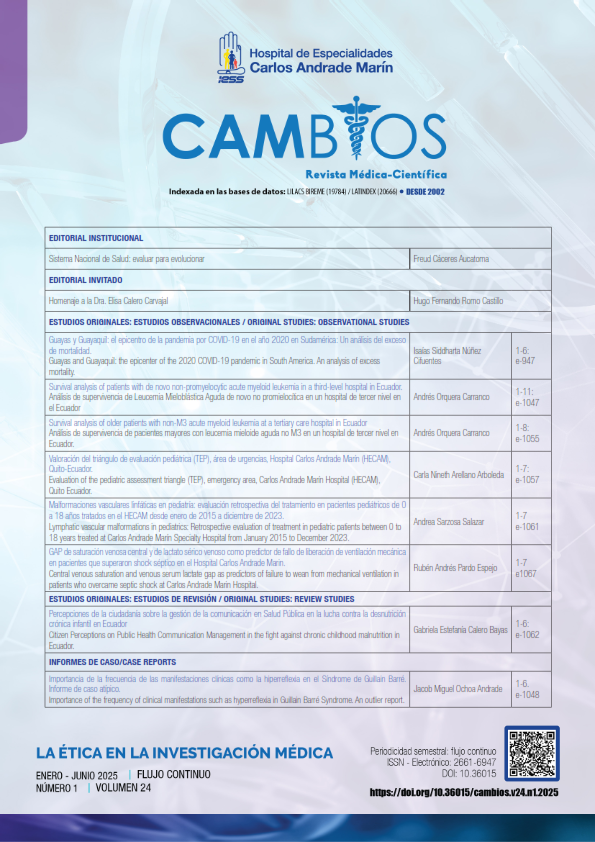
Periodicidad semestral: flujo continuo.
ISSN - Electrónico: 2661-6947 / DOI: 10.36015 • LILACS BIREME (19784); LATINDEX (20666)
INTRODUCCIÓN: Los protocolos de liberación de la ventilación mécanica no consideran el rendimiento cardiaco durante una prueba muy desafiante como lo es la prueba de ventilación espontánea. OBJETIVOS: Determinar si la variación de la saturación venosa central del oxígeno y lactato sérico venoso pueden predecir de fallo de liberación de ventilación mecánica en pacientes que superaron shock séptico en el Hospital Carlos Andrade Marín entre octubre del 20118 y junio del 2019. MATERIALES Y MÉTODOS:
Se desarrolló un estudio descriptivo, observacional de corte transversal.
RESULTADOS: Se analizaron los datos de 62 pacientes, con mayor prevalencia del género masculino el 69,40%, la mediana de la edad es de 62 años (RIQ de 47 – 80), donde el 46,8% pertenece al grupo de mayores a 65 años. La media de días de hospitalización es de 9,8±5,94 días. El promedio de los días de ventilación mecánica 5.54 días con una desviación estándar (DE) de 3.2 días. El promedio APACHE II al ingreso fue de 20,41±6,50. El sitio de infección con mayor prevalencia fue el pulmonar con una representatividad de 50%. El valor promedio para el SOFA al momento de la prueba fue de 6,19±2,98. El 75,8% de los pacientes mostró éxito en la liberación mecánica. La tasa de reintubación fue 11,29%. El punto de corte para el delta de saturación venosa central mayor a 4,5% puede predecir fallo en la liberación de la ventilación mecánica con una sensibilidad de 91,43% y una especificidad del 66,6%, (OR=12,28; IC 95% 2,90: 51,94), VPP; 53,3% y VPN; 86%. ROC; 84,10% (IC 95% 71,6%; 96.6%). El lactato sérico venoso no fue significativo para predecir fallo de la liberación de la ventilación mecánica. Las covariables significativas para el modelo de regresión son el APACHE II al ingreso y el Índice de Charlson con el 90,3% de pronóstico de fallo en la liberación de la ventilación y una significancia para el modelo de p=0,00. CONCLUSIONES: La diferencia de la saturación venosa central de oxigeno resultó significativa para predecir el fallo en la liberación de la ventilación mecánica.
1. Annane D, Aegerter P, Jars-Guincestre MC, Guidet B. Current Epidemiology of Septic Shock: The CUB-Réa Network. Am J Respir Crit Care Med. 15 de julio de 2003;168(2):165-72. DOI: 10.1164/rccm.2201087. Available from:
https://pubmed.ncbi.nlm.nih.gov/12851245/
2. Esteban A, AlíA I, Tobin MJ, Gil A, Gordo F, Vallverdú I, et al. Effect of Spontaneous Breathing Trial Duration on Outcome of Attempts to Discontinue Mechanical Ventilation. Am J Respir Crit Care Med. febrero de 1999;159(2):512-8. DOI: 10.1164/ajrccm.159.2.9803106 . Available from: https://pubmed.ncbi.nlm.nih.gov/9927366/
3. Béduneau G, Pham T, Schortgen F, Piquilloud L, Zogheib E, Jonas M, et al. Epidemiology of Weaning Outcome according to a New Definition. The WIND Study. Am J Respir Crit Care Med. 15 de marzo de 2017;195(6):772-83. https://doi.org/10.1164/rccm.201602-0320OC . Available from: https://www.atsjournals.org/doi/10.1164/rccm.201602-0320OC
4. Esteban A, Alia I, Ibañez J, Benito S, Tobin MJ. Modes of Mechanical Ventilation and Weaning. Chest. octubre de 1994;106(4):1188-93. DOI: 10.1378/chest.106.4.1188. Available from: https://pubmed.ncbi.nlm.nih.gov/7924494/
5.Teixeira C, da Silva NB, Savi A, Vieira SRR, Nasi LA, Friedman G, et al. Central venous saturation is a predictor of reintubation in difficult-to-wean patients*: Crit Care Med. febrero de 2010;38(2):491-6. DOI: 10.1097/CCM.0b013e3181bc81ec. Available from: https://pubmed.ncbi.nlm.nih.gov/19789441/
6. Jubran A, Tobin MJ. Pathophysiologic basis of acute respiratory distress in patients who fail a trial of weaning from mechanical ventilation. Am J Respir Crit Care Med. marzo de 1997;155(3):906-15. DOI: 10.1164/ajrccm.155.3.9117025. Available from: https://
pubmed.ncbi.nlm.nih.gov/9117025/
7. Guyton,A. C & Hall, J. E. (2012). Tratado de fisiología médica (12ª ed.). Elsevier Unidad VII:Respiración: p 465. ISBN: 9788480868198.
8. Feihl F, Broccard AF. Interactions between respiration and systemic hemodynamics. Part I: basic concepts. Intensive Care Med. enero de 2009;35(1):45-54. DOI: 10.1007/s00134-008-1297-z. https://pubmed.ncbi.nlm.nih.gov/18825367/
9. Feihl F, Broccard AF. Interactions between respiration and systemic hemodynamics. Part II: practical implications in critical care. Intensive Care Med. febrero de 2009;35(2):198-205. Available from: https://link.springer.com/chapter/10.1007/978-3-642-01769-8_63
10. Hernández-López GD, Cerón-Juárez R, Escobar-Ortiz D, Graciano-Gaytán L, Gorordo-Delsol LA, Merinos-Sánchez G, et al. Retiro de la ventilación mecánica: Med. crit (Col Mex Med Crit)
31 (4). jul ago 2017. Available from:
https://www.scielo.org.mx/scielo.php?script=sci_arttext&pid=S2448-89092017000400238
11. Martin J. Tobin, Amal Jubran. Principles and practice of mechanical ventilation. third edition. 2013. Available from: https://accessmedicine.mhmedical.com/content.aspx?bookid=520§ionid=41692233
12. Esteban A, Alía I, Gordo F, Fernández R, Solsona JF, Vallverdú I, et al. Extubation outcome after spontaneous breathing trials with T-tube or pressure support ventilation. The Spanish Lung Failure Collaborative Group. Am J Respir Crit Care Med. agosto de 1997;156(2 Pt 1):459-65. DOI: 10.1164/ajrccm.156.2.9610109 . Available from:
https://pubmed.ncbi.nlm.nih.gov/9279224/
13. Esteban, et al., E et al. A Comparison of Four Methods of Weaning Patients from Mechanical Ventilation. N Engl J Med. 1995;6. DOI: 10.1056/NEJM199502093320601 Available from: https://pubmed.ncbi.nlm.nih.gov/7823995/
14. Karthika M, Al Enezi FA, Pillai LV, Arabi YM. Rapid shallow breathing index. Ann Thorac Med. 2016;11(3):167-76. DOI: 10.4103/1817-1737.176876. Available from: https://pubmed.ncbi.nlm.nih.gov/27512505/
15. Sklar MC, Burns K, Rittayamai N, Lanys A, Rauseo M, Chen L, et al. Effort to Breathe with Various Spontaneous Breathing Trial Techniques. A Physiologic Meta-analysis. Am J Respir Crit Care Med. 01 de 2017;195(11):1477-85. DOI: 10.1164/rccm.
201607-1338OC. Available from:
https://pubmed.ncbi.nlm.nih.gov/27768396/
16. MacIntyre NR, Cook DJ, Ely EW, Epstein SK, Fink JB, Heffner JE, et al. Evidence-based guidelines for weaning and discontinuing ventilatory support: a collective task force facilitated by the American College of Chest Physicians; the American Association for Respiratory Care; and the American College of Critical Care Medicine. Chest. diciembre de 2001;120(6 Suppl):375S-95S. DOI:
10.1378/chest.120.6_suppl.375s . Available from:
https://pubmed.ncbi.nlm.nih.gov/11742959/
17. Carrillo-Esper R. Saturación venosa central. Conceptos actuales. Revista Mexicana de Anestesiología. Jul Sept 2007; 30 (3):165-171. Available from:
https://www.medigraphic.com/pdfs/rma/cma-2007/cma073g.pdf
18. Georgakas I, Boutou AK, Pitsiou G, Kioumis I, Bitzani M, Matei K, et al. Central Venous Oxygen Saturation as a Predictor of a Successful Spontaneous Breathing Trial from Mechanical Ventilation: A Prospective, Nested Case-Control Study. Open Respir Med J. 26 de marzo de 2018;12:11-20. doi: 10.2174/1874306401812010011. Available from:
https://pmc.ncbi.nlm.nih.gov/articles/PMC5876926/
19. Jubran A, Mathru M, Dries D, Tobin MJ. Continuous Recordings of Mixed Venous Oxygen Saturation during Weaning from Mechanical Ventilation and the Ramifications Thereof. Am J Respir Crit Care Med. diciembre de 1998;158(6):1763-9. DOI: 10.1164/
ajrccm.158.6.9804056. Available from:
https://pubmed.ncbi.nlm.nih.gov/9847265/
20. Squara P. Central venous oxygenation: when physiology explains apparent discrepancies. Crit Care [Internet]. 2014 [citado 9 de octubre de 2019];18(6). PMCID: PMC4282012 DOI: 10.1186/s13054-014-0579-9 Disponible en:
https://pubmed.ncbi.nlm.nih.gov/25407250/
21.Chittawattanarat K, Kantha K, Tepsuwan T. Central Venous Oxygen Saturation Is not a Predictor of Extubation Success after Simple Weaning from Mechanical Ventilation in Post-Cardiac Surgical Patients. 2016 Sept;99. Suple 6-S145-S152. PMID: 29906372.
Available from: https://pubmed.ncbi.nlm.nih.gov/29906372/

Esta obra está bajo una licencia internacional Creative Commons Atribución-NoComercial-CompartirIgual 4.0.
Derechos de autor 2024 Revista Médica-Científica CAMbios HECAM
