

Periodicidad semestral: flujo continuo.
ISSN - Electrónico: 2661-6947 / DOI: 10.36015 • LILACS BIREME (19784); LATINDEX (20666)
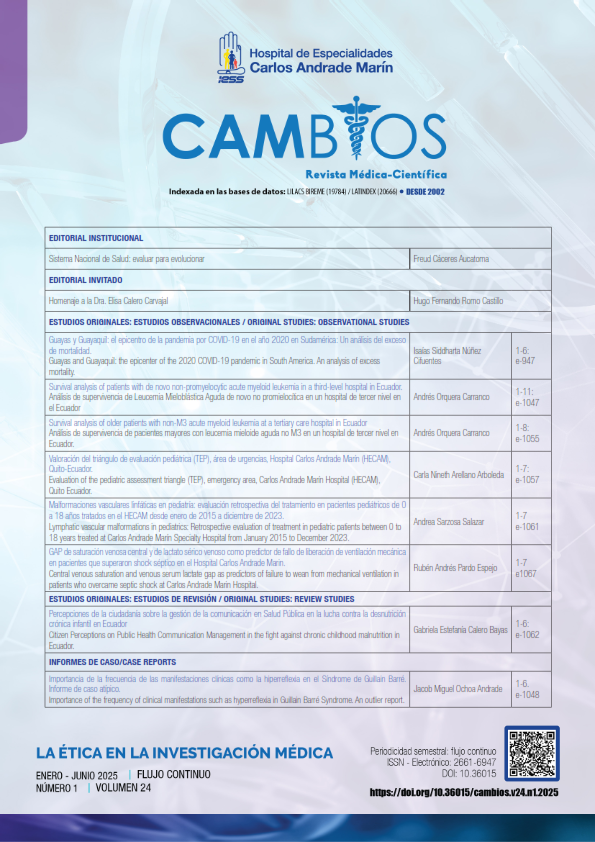
INTRODUCTION: There are a significant number of reports in Latin America, but there are no survival data on acute myeloid leukemia (AML) in Ecuador, so it is important to report the first survival analysis in patients with de novo AML in a reference center in the country.
OBJECTIVES: To evaluate overall survival (OS), relapse-free survival (RFS) and risk factors associated with survival, as well as to describe the most relevant clinical and laboratory characteristics at presentation.
METHODS: We retrospectively reviewed the medical records of 121 patients ≥ 15 years old, with de novo AML candidates for intensive chemotherapy, diagnosed between January 2012 and December 2019 and followed up until December 2021, and a survival analysis (OS and RFS at 5 years) was performed. For the description of the most relevant clinical and laboratory characteristics at presentation, 260 medical records were reviewed, including patients who were not candidates for intensive chemotherapy, those who died before receiving treatment, those who did not wish to receive chemotherapy, secondary AML, or those who were referred to other centers for treatment.
RESULTS:
Of the 121 patients who received intensive chemotherapy, 22.3% died during induction chemotherapy, with 74% of deaths related to multidrug-resistant (MDR) bacteria. The overall treatment-related mortality was 29.7%. The complete response (CR) rate was 54.9% with the first induction in all patients, while in patients ≤ 60 years treated with a 7+3 induction regimen, the CR rate was 79.5%. 12.7% of patients were considered primary refractory. The average number of days between each chemotherapy cycle, including the consolidation phase, was 50.2 days. The 5-year OS was 12.2% (median survival of 8 months) and in patients who received 7+3 induction protocol the 5-year OS was 13.3% (median survival of 8 months). The 5-year RFS was 21.2% (median survival of 13 months). In the multivariate analysis, the adapted intermediate-risk cytogenetics group showed an association with OS, HR of 0.47 (P 0.036). No patient in this cohort had access to hematopoietic stem cell transplantation.
CONCLUSION: The very low OS rates are directly affected by the high mortality associated with treatment in the context of MDR bacterial infections as well as a serious problem of access to bone marrow transplantation, which makes the OS in this study even lower than the Latin American average.
1. Fuentes M, Rojas P, Ernst D, Ocqueteau M, Bertin P, Sarmiento M, et al. Resultados en el tratamiento de pacientes con leucemia mieloide aguda no promielocítica en el Hospital Clínico de la Pontificia Universidad Católica entre los años 2010-2014. Rev Med Chil [Internet]. 2015 Oct 1 [cited 2022 Jun 5];143(10):1269–76. Available from:
https://www.scielo.cl/scielo.php?script=sci_arttext&pid=S0034-98872015001000005
2. Demichelis-Gómez R, Zapata-Canto N, Leyto-Cruz F, Terreros-Muñoz E, Carrillo A, Montaño-Figueroa E, et al. Acute Myeloid Leukemia in Mexico: The Specific Challenges of a Developing
Country. Results From a Multicenter National Registry. Clin Lymphoma Myeloma Leuk [Internet]. 2020 Jun 1 [cited 2022 Jun 5];20(6):e295–303. Available from:
https://pubmed.ncbi.nlm.nih.gov/32192977/
3. Cheson BD, Bennett JM, Kopecky KJ, Büchner T, Willman CL, Estey EH, et al. Revised recommendations of the International Working Group for Diagnosis, Standardization of Response Criteria, Treatment Outcomes, and Reporting Standards for Therapeutic Trials in Acute Myeloid Leukemia. J Clin Oncol [Internet]. 2003 Dec 15 [cited 2022 Sep4];21(24):4642–9. Available from: https://pubmed.ncbi.nlm.nih.gov/14673054/
4. Döhner H, Wei AH, Appelbaum FR, Craddock C, DiNardo CD, Dombret H, et al. Diagnosis and Management of Acute Myeloid Leukemia in Adults: 2022 Recommendations from an International
Expert Panel, on Behalf of the European LeukemiaNet. Blood [Internet]. 2022 Jul 9 [cited 2022 Sep 4]; Available from:
http://www.ncbi.nlm.nih.gov/pubmed/35797463
5. Juliusson G, Antunovic P, Derolf Å, Lehmann S, MöllgårdL, Stockelberg D, et al. Age and acute myeloid leukemia: real world data on decision to treat and outcomes from the Swedish Acute Leukemia Registry. Blood. 2009 Apr 30;113(18):4179–87. Available from:
https://www.science-direct.com/science/article/pii/S0006497120392272
6. Shallis RM, Wang R, Davidoff A, Ma X, Zeidan AM. Epidemiology of acute myeloid leukemia: Recent progress and enduring challenges. Blood Rev. 2019 Jul 1;36:70–87. Available from:
https://pubmed.ncbi.nlm.nih.gov/31101526/
7. Morton LM, Dores GM, Schonfeld SJ, Linet MS, Sigel BS, Lam CJK, et al. Association of Chemotherapy for Solid Tumors with Development of Therapy-Related Myelodysplastic Syndrome or Acute Myeloid Leukemia in the Modern Era. JAMA Oncol. 2019;5(3):318–25.
Available from:
https://pubmed.ncbi.nlm.nih.gov/30570657/
8. Szotkowski, T., Rohon, P., Zapletalová, J., Sicova, K., Hubacek, J., & Indrak, K. Secondary acute myeloid leukemia—a single center experience. Neoplasma 2010: 57(2):170-8. Available from: https://pubmed.ncbi.nlm.nih.gov/20099982/
9. Solh M, Solomon S, Morris L, Holland K, Bashey A. Extramedullary acute myelogenous leukemia. Blood Rev [Internet]. 2016;30(5):333–9. Available from: https://pubmed.ncbi.nlm.nih.gov/27094614/
10. Wu Y-Y, Tang L, Wang M-H. Leukemia and Risk of Venous Thromboembolism: A Meta-analysis and Systematic Review of 144 Studies Comprising 162,126 Patients. .Scientific Reports 7.1 (2017): 1167; Available from:
https://pubmed.ncbi.nlm.nih.gov/28446766/
11. Crespo-Solís E. Thrombosis and acute leukemia. Hematology. 2012;17(SUPPL. 1). S169-73. doi: 10.1179/102453312X13336169 156852.
https://pubmed.ncbi.nlm.nih.gov/22507812/
12. Stone RM. Thrombosis in AML? Yes, but when to worry? Blood. 2016;128(14):1784–5. doi: 10.1182/blood-2016-08-734715. Available from:
https://pubmed.ncbi.nlm.nih.gov/28832329/
13. Wang T. , Leader A, Sanfilippo K.. Thrombosis and bleeding in hematological malignancy. Best Practice & Research Clinical Haematology 35.1 (2022): 101353. Available from: https://pubmed.ncbi.nlm.nih.gov/36030068/
14. Paterno G, Palmieri R, Forte V, Del Prete V, Gurnari C, Guarnera L, et al. Predictors of Early Thrombotic Events in Adult Patients with Acute Myeloid Leukemia: A Real-World Experience. Cancers (Basel). 2022;14(22). Available from:
https://www.mdpi.com/2072-6694/14/22/5640
15. Mitrovic M, Pantic N, Sabljic N, Bukumiric Z, Virijevic M, Pravdic Z, et al. Arterial Thrombosis in Patients with Acute Myeloid Leukemia: Incidence and Risk Factors. Cancers (Basel).
2023;15(11):1–9. Available from:
https://pubmed.ncbi.nlm.nih.gov/37297022/
16. Shaffer LG, Tommerup N, editors. ISCN 2005: an international system for human cytogenetic nomenclature (2005): recommendations of the International Standing Committee on Human Cytogenetic Nomenclature. Karger Medical and Scientific Publishers; 2005. Available from: https://www.ncbi.nlm.nih.gov/nlmcatalog?cmd=PureSearch&term=101256672%5Bnlmid%5D
17. Medeiros BC, Othus M, Estey EH, Fang M, Appelbaum FR. Unsuccessful diagnostic cytogenetic analysis is a poor prognostic feature in acute myeloid leukaemia. Br J Haematol. 2014;164(2):245–50. Available from:
https://pubmed.ncbi.nlm.nih.gov/24383844/
18. Stölzel F, Mohr B, Kramer M, Oelschlägel U, Bochtler T, Kaufmann M, et al. Karyotype complexity and prognosis in acute myeloid leukemia. Blood Cancer J [Internet]. 2016 [cited 2023 Nov 23];6:386. Available from:
https://www.nature.com/articles/bcj2015114
19.Torres-Flores, J., Espinoza-Zamora, R., Garcia-Mendez, J., Cervera-Ceballos, E., Sosa-Espinoza, A., & Zapata-Canto, N. Treatment-Related Mortality From Infectious Complications in an Acute
Leukemia Clinic. Journal of Hematology, 2020: 9(4), 123–131.
https://doi.org/10.14740/jh751
20. Lovato PE. Leucemia mieloide aguda en adultos: Estudio comparativo sobre tratamiento y pronóstico por grupos etarios. Revista Medica Herediana, 26.3 (2015): 160-166. Available from: http://www.scielo.org.pe/scielo.php?pid=S1018-130X2015000300004&script=sci_abstract
21. Kayal, S., Sengar, M., Jain, H., Bonda, A., George, B., Kulkarni, U. P., Kapoor, R. Induction related mortality in acute myeloid leukemia: multivariate model of predictive score from the Indian Acute
Leukemia Research Database (INwARD) of the Hematology Cancer Consortium (HCC). Blood 134 (2019): 2615. DOI:
https://doi.org/10.1182/blood-2019-127623. Available from: https://www.sciencedirect.com/science/article/pii/S0006497118605440
22. Othus, M., Kantarjian, H., Petersdorf, S., Ravandi, F., Godwin, J., Cortes, J., Pierce, S., Erba, H., Faderl, S., Appelbaum, F. R., & Estey, E. (2014). Declining rates of treatment-related mortality in patients with newly diagnosed AML given “intense” induction regimens: A report from SWOG and MD Anderson. Leukemia, 28(2), 289–292. DOI: https://doi.org/10.1038/leu.2013.176. Available from: Declining rates of treatment-related mortality in patients with newly diagnosed AML given ‘intense’ induction regimens: a report from SWOG and MD Anderson | Leukemia (nature.com)
23. Campos CC, Caldas LM, Silva LT, Botura M, Almeida A de M, Schriefer AL, et al. 10-Year Real-World Data on Acute Myeloid Leukemia: The Paradigm of a Public Health Center in Brazil.
Blood [Internet]. 2020;136(Supplement 1):33–4. DOI: http://dx.doi.org/10.1182/blood-2020-140858, Available from: 10-Year Real-World Data on Acute Myeloid Leukemia: The Paradigm of a Public
Health Center in Brazil | Blood | American Society of Hematology (ashpublications.org).
24. Koenig, K., & Mims, A. (2020). Relapsed or primary refractory AML: Moving past MEC and FLAG-ida. In Current Opinion in Hematology (Vol. 27, Issue 2, pp. 108–114). Lippincott Williams and
Wilkins. https://doi.org/10.1097/MOH.0000000000000561
25. Thol, F., Schlenk, R. F., Heuser, M., & Ganser, A. (2015). How I treat refractory and early relapsed acute myeloid leukemia. In Blood (Vol. 126, Issue 3, pp. 319–327). American Society of Hematology.
DOI: https://doi.org/10.1182/blood-2014-10-551911. Available 10 / 10 CAMbios 24(1) 2025 /e1047
Orquera A, Mendieta L, Velasco P, Carranza J, Muñoz G, Arévalo M. from: https://doi.org/10.1182/blood-2014-10-551911
26. Rego EM, Higashi M, Romero MA, Enrico AI, Fernandez II, Jarchum G, et al. Real-World Study in Acute Leukemia: Epidemiology, Treatment Patterns and Outcomes for Newly Diagnosed AML
in Adult Patients from Latin America - Loyal Study. Blood [Internet]. 2023 Nov 2 [cited 2023 Dec 24];142(Supplement 1):2855–2855. DOI: https://dx.doi.org/10.1182/blood-2023-187150. Available
from: Real-World Study in Acute Leukemia: Epidemiology, Treatment Patterns and Outcomes for Newly Diagnosed AML in Adult Patients from Latin America - Loyal Study | Blood | American
Society of Hematology (ashpublications.org)
27. Koschade SE, Stratmann JA, Finkelmeier F, Wagner S, Chromik J, Steffen B, et al. Relapse surveillance of acute myeloid leukemia patients in first remission after consolidation chemotherapy: diagnostic value of regular bone marrow aspirations. Ann Hematol [Internet].
2022 Aug 1 [cited 2023 Dec 24];101(8):1703. Available from: https://pubmed.ncbi.nlm.nih.gov/35595925/
28. Thol F, Ganser A. Treatment of Relapsed Acute Myeloid Leukemia. Curr Treat Options Oncol [Internet]. 2020 Aug 1 [cited 2023 Dec 24];21(8):66. Available from:
https://pubmed.ncbi.nlm.nih.gov/32601974/
29. Nilsson C, Linde F, Hulegårdh E, Garelius H, Lazarevic V, Antunovic P, et al. Characterization of therapy-related acute myeloid leukemia: increasing incidence and prognostic implications. Haematologica [Internet]. 2023 Apr 4 [cited 2024 Jan 1];108(4):1015. Available from: https://pubmed.ncbi.nlm.nih.gov/36005563/
30. Shallis RM, Wang R, Davidoff A, M X, Zeidan AM. Epidemiology of acute myeloid leukemia: Recent progress and enduring challenges. Blood Rev 2019 Jul: 36: 70-87. doi: 10.1016/j.blre.2019.04.005. Available from:
https://pubmed.ncbi.nlm.nih.gov/31101526/
31. Nilsson c, Linde F, Hulegardh E, Garelius H, Lazarevic V, Antunovic P, et al. Characterization of therapy related acute myeloid leukemia: increasing incidence and prognostic implicatios. Haematologica [Internet]. 2023 Apr.4 ; 108 (4): 1015. Available from:
https://pubmed.ncbi.nlm.nih.gov/36005563/
32. Canadian Cancer Society. Adult Acute Myeloid Leukemia Treatment – Health Professional Version. Shallis RM, Wang R, Davidoff A, Ma X, Zeidan AM. Epidemiology of acute myeloid leukemia: Recent progress and enduring challenges. Blood Rev. 2019 Jul 1;36:70–87. Accessed January 1, 2024.

This work is licensed under a Creative Commons Attribution-NonCommercial-ShareAlike 4.0 International License.
Copyright (c) 2024 Medical-Scientific Journal CAMbios HECAM
