

Periodicidad semestral: flujo continuo.
ISSN - Electrónico: 2661-6947 / DOI: 10.36015 • LILACS BIREME (19784); LATINDEX (20666)
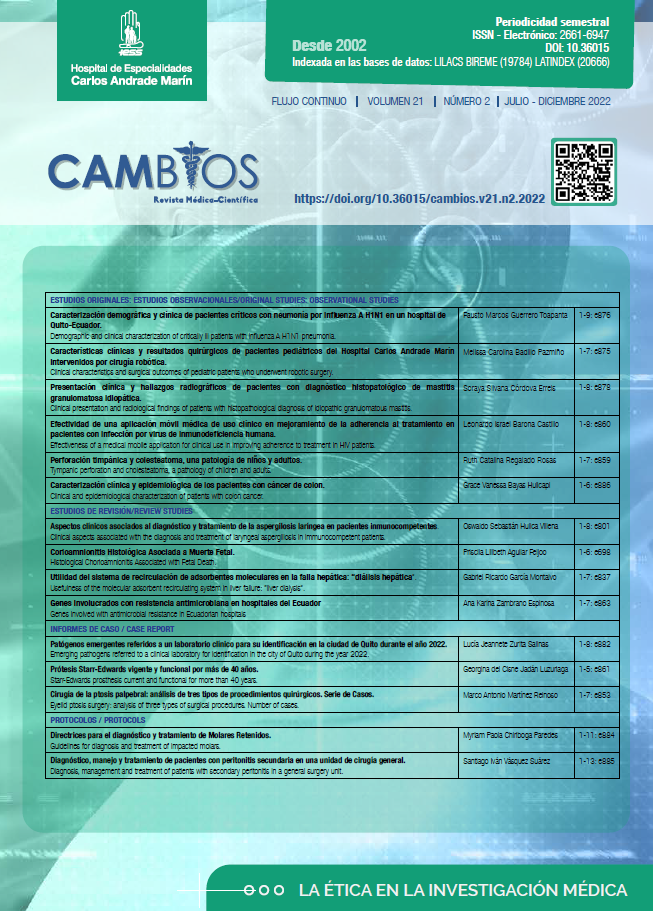
INTRODUCTION. Ear pathology is a frequent disease in our environment, associated with repeated ear infections, with the presence of tympanic perforation and cholesteatoma, which will determine the presence of much more accentuated lesions in terms of auditory evolution or local or systemic complications. OBJECTIVE. To determine the association between the presence of cholesteatoma and tympanic perforation
in patients with chronic otitis media. MATERIALS AND METHODS. Retrospective analytical epidemiological study. Population of 4 733 and sample of 75 patients for cases and 75 for controls based on clinical histories taken from the AS 400 computer system, who attended the Otorhinolaryngology outpatient clinic of the Carlos Andrade Marín Specialties Hospital in the period from January 2018 to December 2019;
Inclusion criteria for case group: Men and women aged 20 to 65 years, diagnosis of chronic otitis media, diagnosis of otic cholesteatoma. Inclusion criteria for controls group: men and women aged 20 to 65 years, no diagnosis of cholesteatoma. RESULTS. A strong relationship was observed between having tympanic perforation and the development of cholesteatoma with an OR value of 33,14 with a 95% CI of 31,94
- 34,34, thus proving the study hypothesis. It was determined that tympanic perforation is a risk factor associated with the development of cholesteatoma in patients with chronic otitis media, the prevalence of cholesteatoma in relation to age was 72% in patients aged 41 to 65 years, with greater predominance in women in 57,3%. DISCUSSION. The presence of tympanic perforation according to what was observed is a risk factor for the development of cholesteatoma, mostly linked to Chronic Otitis Media. CONCLUSIONS. It was confirmed that tympanic perforation is a risk factor in the development of cholesteatoma in patients with chronic otitis media, which demonstrates the need for updated and continuous management in patients with this ear pathology. Studies with larger samples are required to determine other risk factors such as sex, education level and age that could influence the development of cholesteatoma.
Anggraeni, Ratna, Phyllis Carosone-Link, Bulantrisna Djelantik, Eka P. Setiawan, Widya W. Hartanto, Abla
Ghanie, Denny S. Utama, et al. “Otitis Media Related Hearing Loss in Indonesian School Children.” International
Journal of Pediatric Otorhinolaryngology 125 (June 19, 2019): 44–50.
DOI: 10.1016/j.ijporl.2019.06.019.
Trelles García DP, Trelles García VP. Perforación De La Membrana Timpánica: Características Clínicas, Epidemiológicas Y Modalidades De Manejo. Hospital José Carrasco Arteaga. Cuenca – Ecuador. 2011 - 2015. [Tesis] Universidad De Cuenca, 2016. Disponible en:
https://dspace.ucuenca.edu.ec/bitstream/123456789/25338/1/TESIS%20.pdf
Campos Navarro LA, Barrón Soto M, Fajardo Dolci G. Otitis media aguda y crónica, una enfermedad frecuente
y evitable. Revista de La Facultad de Medicina (México) 57. no. 1 (February 2014): 5–14. Disponible en:
https://www.scielo.org.mx/scielo.php?script=sci_arttext&pid=S0026-17422014000100002
Wallis S, Atkinson H, Coatesworth AP. Chronic Otitis Media. Postgraduate Medicine (May 2015): 127 (4): 391–
DOI: 10.1080/00325481.2015.1027133.
Gutiérrez Céléry D, Godoy Villegas A, Cárdenas Serón J, Argomedo Saavedra FJ. Protocolo de Referencia y
Contrarreferencia En Otitis Media Crónica. Chile. Hospital San José. 2018. Disponible en:
De Juan Beltrán J, Virós Porcuna C, Orús Dotú C. Bases Anatómicas Del Oído y el Hueso Temporal. Capítulo 2.
En Libro De Formacion Virtual En ORL, 1–29, 2008. Disponible en:
Mittal R, Lisi C, Gerring R, Mittal J, Mathee K, Narasimhan G, et al. Current Concepts in the Pathogenesis and
Treatment of Chronic Suppurative Otitis Media. Journal Medical Microbiology. 2015: 64 (10): 1103–16. Available
from:
https://pubmed.ncbi.nlm.nih.gov/26248613/
Barttol P. ORL. Accessed September 28, 2019. Available from:
https://www.sefh.es/bibliotecavirtual/fhtomo2/CAP16.pdf.
Yamamoto Y, TaKahashi K, Morita Y, Takahashi S. “Clinical behavior and pathogenesis of secondary acquired
cholesteatoma with a tympanic membrane perforation”. Acta OtoLaryngologica. 2013; 133: 1035–1039. Available
from:
https://pubmed.ncbi.nlm.nih.gov/23848236/
Tran Ba Huy P. Otitis media crónica. Historia natural y formas clínicas. EMC - Otorrinolaringología 34, no.
(January 2005): 1–27. Disponible en:
https://www.em-consulte.com/es/article/44078/otitis-media-cronica-historia-natural-y-formas-cli.
Flint PW, Robbins T, Haughey B,. Lund V, Robbins K, Thomas et al. Cummings Otolaryngology Head And Neck
Surgery. Sexta. Philadelphia: Elsevier Saunders, 2015.
ISBN: 9780323612166
Solanki B, Sharma S; “Cholesteatoma Versus Granulations: Changing Incidence Trends and Association with
Age and Complications”; Indian J Otolaryngol Head Neck Surg. 2020 Jun;72(2):208-213.
DOI: 10.1007/s12070-019-01765-0
Chung J, Hwan Lee S, Young Woo S, Woo Kim S, Sun Cho Y, “ Prevalence and associated factors of chronic suppurative otitis media: Data from the Korea National Health and Nutrition Examination Survey, 2009–2012.
The Laryngoscope. 2016; 126: 2351-2357. Available from:
https://pubmed.ncbi.nlm.nih.gov/27076099/
Jackson R, Addison AB, Prinsley PR. Cholesteatoma in children and adults: are there really any differences? J Laryngol Otol 2018;1–4.
DOI: 10.1017/S0022215118000890
Shaheen M, Raquib A, Muniruddin Ahmad S; “Prevalence and associated socio-demographic factors of chronic suppurative otitis media among rural primary school children of Bangladesh”; International Journal of Pediatric Otorhinolaryngology 76 (2012) 1201–1204. Available from:
https://pubmed.ncbi.nlm.nih.gov/22652497/
Bhutta, Mahmood F., Ruth B. Thornton, Lea-Ann S. Kirkham, Joseph E. Kerschner, and Michael T. Cheeseman.
“Understanding the Aetiology and Resolution of Chronic Otitis Media from Animal and Human Studies.” Disease
Models & Mechanisms 10, no. 11 (November 1, 2017): 1289–1300.
DOI: 10.1242/dmm.029983
Manabu Komori, Takeshi Tada, Hiromi Koizumi, et al; “Practical analysis of pars flaccida cholesteatoma with classification and staging system proposed by Japan Otological Society: a comparative study”; Acta Oto-Laryngologica, 2018; 138:11, 977-980,
DOI: 10.1080/00016489.2018.1498593
Bächinger D, Röösli C, Ditzen B, Huber AM; “Development and validation of the Zurich chronic middle ear inventory (ZCMEI-21): an electronic questionnaire for assessing quality of life in patients with chronic otitis media”; Eur Arch Otorhinolaryngol. 2016 Oct;273(10):3073-81. Available from:
https://link.springer.com/article/10.1007/s00405-016-3915-7
Louw, L. “Acquired cholesteatoma: summary of the cascade of molecular events.” The Journal of Laryngology
& Otology, June 2013. Available from:
Wiatr A, Job K, Składzień J, Wiatr M. Chronic suppurative otitis media with cholesteatoma and chronic otitis media with granulation investigated by scanning electron microscope based on an analysis of 140 patients. Polish Journal of Otolaryngology. No. 75 (3) Febrero 2021: 21-27. Available from: https://pubmed.ncbi.nlm.nih.gov/33949967/
Kuczkowski J, Brzoznowski W, Nowicki T. Bone Damage in Chronic Otitis Media. Ear, Nose & Throat Journal. Agosto 2022;101(7):428-429.
DOI:10.1177/0145561320955124
The authors who publish in this journal accept the following conditions:

1. The authors retain the copyright and grant to the CAMbios MEDICAL-SCIENTIFIC JOURNAL HECAM the right of the first publication, with the work registered with the Creative Commons attribution license, which allows third parties to use the published material provided that they mention the authorship of the work and the first publication in this journal.
2. Authors can make other independent and additional contractual agreements for the non-exclusive distribution of the version of the article published in this journal (for example, include it in an institutional repository or publish it in a book) as long as it clearly indicates that the work was published. for the first time in the CAMbios MEDICAL-SCIENTIFIC JOURNAL HECAM.
