

Periodicidad semestral: flujo continuo.
ISSN - Electrónico: 2661-6947 / DOI: 10.36015 • LILACS BIREME (19784); LATINDEX (20666)
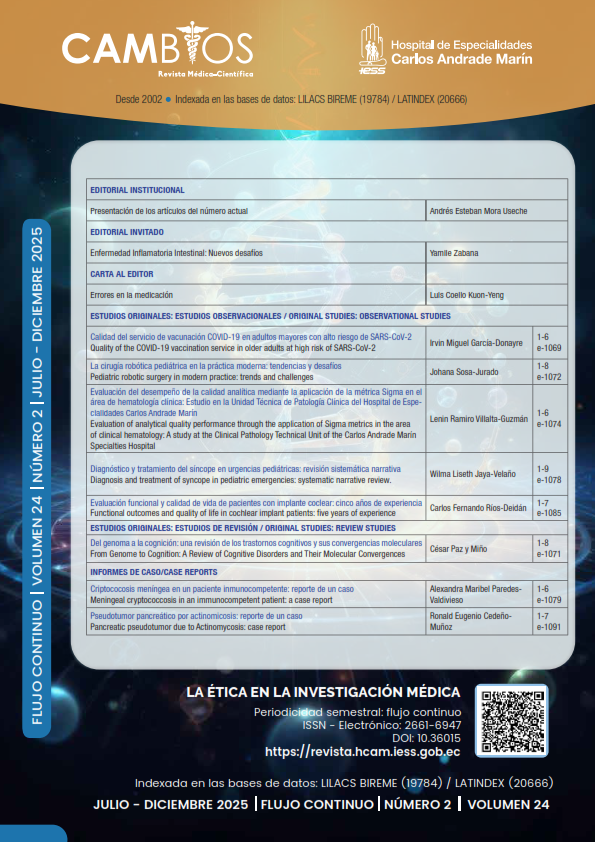
INTRODUCCIÓN: El síncope en urgencias pediátricas constituye un desafío diagnóstico y terapéutico, debido a posibles etiologías benignas como potencialmente graves, lo que exige un enfoque sistemático y multidisciplinario para garantizar la detección temprana y el manejo adecuado.
OBJETIVOS: El objetivo del presente estudio fue determinar el manejo diagnóstico y terapéutico
del síncope en la urgencia pediátrica según evidencia científica.
MATERIALES Y MÉTODOS: Se realizó una revisión sistemática narrativa de la literatura sobre el síncope en urgencias pediátricas, durante el período de 2019 a 2025, de acuerdo con las directrices de la declaración PRISMA. La búsqueda bibliográfica se realizó en las bases de datos: PubMed, Cochrane Libray, EMBASE y SciELO.
RESULTADOS: Los resultados de interés incluyeron la unificación de definiciones, etiología, criterios diagnósticos y terapéuticos, además de exámenes complementarios para el manejo de síncope en los servicios de urgencias pediátricas. Se incluyeron: 41 estudios (9 revisiones sistemáticas, 3 metaanálisis, 1 ensayo clínico controlado, 3 guías de práctica clínica, 2 protocolos, 13 revisiones narrativas y 10 artículos científicos) se consolidó criterios diagnósticos y
terapéuticos para el manejo del síncope en urgencias pediátricas.
CONCLUSIONES: En conclusión, el manejo de síncope en urgencias pediátricas requiere un enfoque diagnóstico sistemático enfocado en una detallada historia clínica y una exploración física minuciosa, tomando en consideración los signos de alerta y comorbilidades asociadas.
Es fundamental priorizar un adecuado estado de hidratación e incremento del consumo de sal,
además de proporcionar educación sanitaria al paciente y sus familiares.
1. Fernández R, Gonzalez J. Diagnóstico y tratamiento del síncope. Sociedad Española de Urgencias Pediatricas. 2020; 1:177-182. Disponible en: https://www.aeped.es/sites/default/files/documentos/
14_sincope.pdf
2. Williams E, Farhaan K, Claydon V. Counter pressure maneuvers for syncope prevention: A semi-systematic review and meta-analysis. Front Cardiovasc Med. 2022; 9:1016420. Disponible en:
http://dx.doi.org/10.3389/fcvm.2022.1016420
3. Alghamdi M, Alshahrani F, Aldihan F, Alamer N, Al Dihan F,
Omair A, Suliman I, Mohamud M. Knowledge and awareness
of syncope among the population of Riyadh: A cross-sectional
study. Cureus. 2022;14(8): e28499. Disponible en:
http://dx.doi.org/10.7759/cureus.28499
4. Viadero M, Fernández N, Garde J, Díaz M. Síncope en la edad
pediátrica. Bol Pediatr. 2021 Jan. 1;61(255):42-5. Disponible en:
https://boletindepediatria.org/boletin/article/view/143
5. Ferreira R, Leite P, Fonseca H, Alves Z, de Carvalho C. Neurally Mediated Syncope in Children and Adolescents: An
Updated Narrative Review. Open Cardiovasc Med J, 2022;
16: e187419242205110. Disponible en: https://opencardiovascularmedicinejournal.com/VOLUME/16/ELOCATOR/e187419242205110/
6. Gundogdu Coban D, Coban M, Muhammet M, Serdar POP, Oner O. A systematic review for clinical assessment of syncope pediatric patients. Arch Emerg Med Intensive Care. 2021;4(1):9–13. Disponible en: https://sryahwapublications.com/article/abstract/
2638-5007.0401002
7. Li HX, Gao L, Yuan Y. Advance in the understanding of vasovagal syncope in children and adolescents. World J Pediatr. 2021;17(1):58–62. Disponible en: http://dx.doi.org/10.1007/s12519-020-00367-z
8. Cuzzocrea G, Fontana A, Mascanzoni M, Manca F, Pecora R, Trani L, Guido C, Spalice A, Versacci P, Sideli L, Caretti V. Psychopathological correlates and psychosocial functioning in children and adolescents with syncope: A systematic review. Clin Neuropsychiatry. 2024;21(5):358–75. Disponible en: http://dx.doi.org/10.36131/cnfioritieditore20240502. Available from:
https://pubmed.ncbi.nlm.nih.gov/39540075/
9. Hutse I, Coppens M, Herbelet S, Seyssens L, Marks L. Syncope in dental practices: A systematic review on aetiology and management. J Evid Based Dent Pract. 2021;21(3):101581. Disponible en: http://dx.doi.org/10.1016/j.jebdp.2021.101581. Available from: https://www.sciencedirect.com/science/article/pii/
S1532338221000567?via%3Dihub
10. Khalaji A, Behnoush A, Tajdini M. Association between vitamin D deficiency and vasovagal syncope: A systematic review and meta-analysis. Clin Cardiol. 2023;46(7):721–8. Disponible en: http://dx.doi.org/10.1002/clc.24035. Available from:
https://onlinelibrary.wiley.com/doi/10.1002/clc.24035
11. Karaca S, Özbingöl D, Karaca P, Yavuz M, Nişli K. Pediatric
syncope: An examination of diagnostic processes, therapeutic
approaches and the role of the tilt test: Insights from an 18-year single-center experience. Children (Basel). 2025;12(4). Disponible en:
https://www.mdpi.com/2227-9067/12/4/459
12. Sutton R, Ricci F, Fedorowski A. Risk stratification of syncope: Current syncope guidelines and beyond. Auton Neurosci.2022; 238:102929. Disponible en: http://dx.doi.org/10.1016/j.autneu.2021.102929. Available from:
https://www.autonomicneuroscience.com/article/S1566-0702(21)00159-4/fulltext
13. Salari N, Karimi Z, Hemmati M, Mohammadi A, Shohaimi S, Mohammadi M. Global prevalence of vasovagal syncope: A systematic review and meta-analysis. Glob Epidemiol. 2024;7(100136):100136. Disponible en: http://dx.doi.org/10.1016/j.gloepi.2024.100136.
Available from: https://www.sciencedirect.com/science/article/pii/
S2590113324000026?via%3Dihub
14. Stewart JM, van Dijk JG, Balaji S, Sutton R. A framework to
simplify paediatric syncope diagnosis. Eur J Pediatr. 2023;
182(11):4771–80. Disponible en: http://dx.doi.org/10.1007/
s00431-023-05114-w. Available from: https://link.springer.com/
article/10.1007/s00431-023-05114-w
15. Thijs RD, Brignole M, Falup-Pecurariu C, Fanciulli A, Freeman R, Guaraldi P, Jordan J, Habek M, Hilz M,Pavy-LeTraon A, Stankovic I, Struhal W, Sutton R, Wenning G, van Dijk G. Recommendations for tilt table testing and other provocative cardiovascular autonomic tests in conditions that may cause transient loss of consciousness: Consensus statement of the European Federation of Autonomic Societies (EFAS) endorsed by the American Autonomic Society (AAS) and the European Academy of Neurology (EAN). Auton Neurosci. 2021;233(102792):102792. Disponible en:
http://dx.doi.org/10.1016/j.autneu.2021.102792. Available from: https://www.autonomicneuroscience.com/article/S1566-0702(21)00022-9/fulltext
16. Furlan L, Jacobitti Esposito G, Gianni F, Solbiati M, Mancusi C, Costantino G. Syncope in the emergency department: A practical approach. J Clin Med. 2024;13(11):3231. Disponible en: http://dx.doi.org/10.3390/jcm13113231. Available from: https://pubmed.ncbi.nlm.nih.gov/38892942/
17. Liao Y, Du J. Pathophysiology and individualized management of vasovagal syncope and postural tachycardia syndrome in children and adolescents: An update. Neurosci Bull. 2020;36(6):667–81. Disponible en: http://dx.doi.org/10.1007/s12264-020-00497-4.
Available from: https://link.springer.com/article/10.1007/s12264-020-00497-4
18. Bhandari N 0& Zaidi A. An urgent care approach to syncope
in children and adolescents. Pediatric Urgent Care. 2021.
Disponible en línea.
https://www.jucm.com/wp-content/uploads/2021/09/2021-151129-33-Pediatric-Urgent-Care.pdf
19. Kaza N, Sorbini M, Liu Z, Johal M, Porter B, Nowbar A, Levy
S, Dani M, Taraborelli P, Eardley P, Zuhair M, Arnold A, Howard
J, Whinnett Z, Francis D, Shun-Shin M, Boon Lim P, Keene
D. Therapeutic options for neurocardiogenic syncope: a meta-
analysis of randomised trials with and without blinding: Open
Heart 2024;11:e002669. Disponible en: http://dx.doi.org/10.1136/openhrt-2024-002669. Available from: https://openheart.bmj.com/content/11/1/e002669
20. Tao C, Cui Y, Zhang C, Liu X, Zhang Q, Liu P, Zhang Q, Liu P,
Wang Y, Du J, Jin H. Clinical efficacy of empirical therapy in children with vasovagal syncope. Children (Basel). 2022;9(7):1065. Disponible en: http://dx.doi.org/10.3390/children9071065. Available from: https://pubmed.ncbi.nlm.nih.gov/35884049/
21. Wang Y, Wang Y, Li X, Du J, Zhang H, Jin H, Liao Y. Efficacy
of increased salt and water intake on pediatric vasovagal syncope: A meta-analysis based on global published data. Front Pediatr. 2021; 9:663016. Disponible en: http://dx.doi.org/10.3389/fped.2021.663016. Available from: https://pmc.ncbi.nlm.nih.gov/articles/PMC8155624/
22. Lei LY, Raj S, Sheldon R. Midodrine for the prevention of vasovagal syncope: a systematic review and meta-analysis. Europace. 2022;24(7):1171–8. Disponible en: http://dx.doi.org/10.1093/europace/euab323. Available from: https://academic.oup.com/europace/article/24/7/1171/6506557
23. Yi S, Kong Y, Kim S. Fludrocortisone in pediatric vasovagal syncope: A retrospective, single-center observational study. J Clin Neurol. 2021;17(1):46–51. Disponible en: https://thejcn.com/DOIx.php?id=10.3988/jcn.2021.17.1.46
24. Zhu W, Bian X, Lv J. Advances in diagnosis, management, and long-term outcomes of pediatric vasovagal syncope: a comprehensive review. Front Cardiovasc Med. 2025; 12:1481749. Disponible en: http://dx.doi.org/10.3389/fcvm.2025.1481749. Available from:
https://pubmed.ncbi.nlm.nih.gov/40351605/
25. Ahmadi A, Sabri M, Navabi Z, Dehghan B, Taheri M, Mahdavi C. The impact of self-care recommendations with and without tilt-training on Quality of Life in children and adolescents with vasovagal syncope: A randomized clinical trial. Iran J Nurs Midwifery Res. 2024;29(3):358–67. Disponible en: http://dx.doi.org/10.4103/ijnmr.ijnmr_137_23. Available from: https://journals.lww.com/jnmr/fulltext/2024/29030/the_impact_of_self_care_recommendations recommendations_
with_and.13.aspx
26. Hockin B, Heeney N, Whitehurst D, Claydon V. Evaluating the impact of orthostatic syncope and presyncope on quality of life: A systematic review and meta-analysis. Front Cardiovasc Med. 2022; 9:834879. Disponible en: https://www.frontiersin.org/journals/cardiovascular-
medicine/articles/10.3389/fcvm.2022.834879/full
27. Martone A, Parrini I, Ciciarello F, Galluzzo V, Cacciatore S, Massaro C, Giordano R, Giani T, Landi G, Massimo M, Colivicchi F, Gabrielli D, Oliva F, Zuccala G. Recent advances and future directions in syncope management: A comprehensive narrative review. J Clin Med. 2024;13(3). Disponible en: https://www.mdpi.com/2077-0383/13/3/727
28. Uppoor R, Patel K. Syncope: Diagnostic Yield of various clinical investigations. Cureus. 2022;14(3): e23596. Disponible en: http://dx.doi.org/10.7759/cureus.23596. Available from: https://www.cureus.com/articles/90319-syncope-diagnostic-yield-of-various-clinical-investigations#!/
29. El_deen Z, Nazeer M, Ahmed F. Evaluation of children with syncope: A clinical audit at Assiut University Children Hospital. J Curr Med Res Pract. 2023;8(4):195–201. Disponible en: http://dx.doi.org/10.4103/jcmrp.jcmrp_65_23. Available from: https://journals.lww.com/cmrp/fulltext/2023/08040/evaluation_of_children_with_syncope__a_clinical.6.aspx
30. González J, Perez M. Síncope. Seup.org. 4 Ed. 2024. Disponible en:
https://seup.org/wp-ontent/uploads/2024/04/14_Sincope_4ed.
pdf.
31. Yeom J, Woo H. Pediatric syncope: pearls and pitfalls in history taking. Clin Exp Pediatr. 2023;66(3):88–97. Disponible en: http://dx.doi.org/10.3345/cep.2022.00451. Available from: https://www.e-cep.org/journal/view.php?doi=10.3345/cep.2022.00451
32. Franjić, S. Syncope in children. Journal of Pediatrics Neonatal Biology, 2022. 7(1), 63–67. Disponible en: https://d1wqtxts1xzle7.cloudfront.net/86153472/Syncope_in_Children-libre.pdf
33. Zavala R, Metais B, Tuckfield L, DelVecchio M, Aronoff S.
Pediatric syncope: A systematic review. Pediatr Emerg Care.
2020;36(9):442–5. Disponible en: https://journals.lww.com/
pec-online/fulltext/2020/09000/pediatric_syncope__a_systematic_
review.7.aspx
34. Canakci M, Sevik O, Acar N. How should we approach syncope in the emergency department? Current perspectives. Open Access Emerg Med. 2022; 14:299–309. Disponible en: http://dx.doi.org/10.2147/OAEM.S247023. Available from: https://www.dovepress.com/how-should-we-approach-syncope-in-the-emergencydepartment-
current-per-peer-reviewed-fulltext-article-OAEM
35. Krishna M, Kunde M. A clinical approach to syncope. Indian Journal of Practical Pediatrics. 2020;22(1): 92. Disponible en: https://es.scribd.com/document/471679086/A-clinical-approach-to-syncope
36. Choi Y, Han M, Lee E. Children with transient loss of consciousness: Clinical characteristics and the effectiveness of diagnostic tests. Pediatr Neonatol. 2020;61(6):584–91. Disponible en: http://dx.doi.org/10.1016/j.pedneo.2020.06.006. Available from:
https://www.pediatr-neonatol.com/article/S1875-9572(20)30099-1/fulltext
37. Wang C, Wang S, Doi S, Liao Y, Du J, Jin H. Diagnosis and treatment of neurally mediated syncope in children and adolescents: A hot issue in pediatrics. Medicine Plus. 2024;1(4):100061. Disponible en: http://dx.doi.org/10.1016/j.medp.2024.100061. Available
from: https://www.sciencedirect.com/science/article/pii/
S2950347724000574?via%3Dihub
38. Wang C, Liao Y, Wang S, Tian H, Huang M, Dong X-Y, Shi L,
Li Y, Sun J, Du J, Jin H. Guidelines for the diagnosis and treatment of neurally mediated syncope in children and adolescents (revised 2024). World J Pediatr. 2024;20(10):983–1002. Disponible en:
http://dx.doi.org/10.1007/s12519-024-00819-w. Available
from: https://www.sciencedirect.com/science/article/pii/
S2950347724000574?via%3Dihub
39. Winder M, Marietta J, Kerr L, Puchalski M, Zhang C, Ware
A, Collin G. Reducing unnecessary diagnostic testing in pediatric syncope: A quality improvement initiative. Pediatr Cardiol.2021;42(4):942–50. Disponible en: http://dx.doi.org/10.1007/s00246-021-02567-4. Available from: https://link.springer.com/article/10.1007/s00246-021-02567-4
40. Ortigado Matamala, A. Síncopes. Pediatría Integral, XXV (8),
399–405. Disponible en: https://www.pediatriaintegral.es/publicacion-2021-12/sincopes-2021/
41. Wang S, Peng Y, Zou R, Wang Y, Cai H, Li F, Luo X, Zhang
J, He Z, Wang C. The relationship between demographic factors
and syncopal symptom in pediatric vasovagal syncope. Sci Rep. 2023;13(1):22724. Disponible en: http://dx.doi.org/10.1038/s41598-023-49722-w. Available from: https://www.nature.com/articles/s41598-023-49722-w

Esta obra está bajo una licencia internacional Creative Commons Atribución-NoComercial-CompartirIgual 4.0.
Derechos de autor 2025 Revista Médica-Científica CAMbios HECAM
